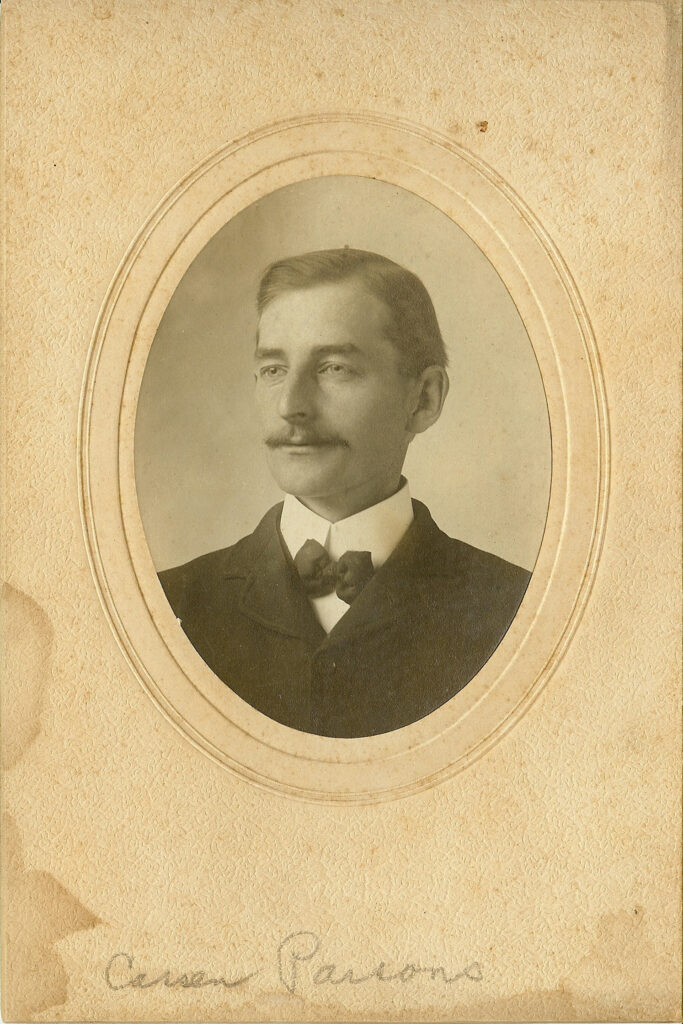
Cassen Parsons
August 7, 1877 - February 22, 1946
Cassen Eugene Parsons was born in 1877 in Grand Blanc to Abigail (Parker) and Edward Parsons. Edward was a deacon at the Congregational Church, where our museum currently resides. Growing up on the family homestead on Cook Road near Holly Road (the farmhouse still stands on the property), Cassen went to the Halsey School in southern Grand Blanc, then later attended the Moody Bible Institute in Chicago and the Michigan Agricultural College (now known as MSU). After M.A.C., Cassen went to London, England and took classes at Livingstone College, a school which trained people for missionary work.
All of that education prepared Cassen for his work in China as a missionary, commencing in 1903. While there, the Kuangren Famine of 1906-07 occurred along the Huai and Yangtze Rivers, resulting in extensive famine in the region. That crisis caused as many as 25 million deaths from the flooding, starvation, and subsequent riots. The United States was the primary country which provided money and food relief to help China recover. As Superintendent of Transportation for the China Inland Mission, Cassen Parsons was one of the 100 people from nineteen missionary groups who helped distribute the food donations to the people in the region. Along with distribution duties, Cassen helped coordinate the opening of the Little Yellow River. Cassen attributes the aid to saving over a million people. His famine relief contributions were recognized by the Chinese emperor in 1907.
After leaving China in 1909, Cassen traveled to several countries, including Egypt and Israel, before returning to the United States. From 1911-14 Parsons took classes at the Yale Divinity and Graduate Schools in Connecticut. During this time Cassen started the Oriental Lecture Bureau, drawing upon his six years of experience in China dealing with famine, war, and the evolution of the country and giving lectures around the United States. He also wrote articles which were published in newspapers across the country which discussed topics such as China, World War I, and Michigan history. His love of history was reflected in a manuscript he wrote which discussed early Indian activity, the Treaty of 1819, the first white settlers in the area around Grand Blanc, and other topics. Cassen passed away in 1946 at the age of 68 and is buried in Evergreen Cemetery in Grand Blanc.